Ocean Liners vs. Cruise Ships
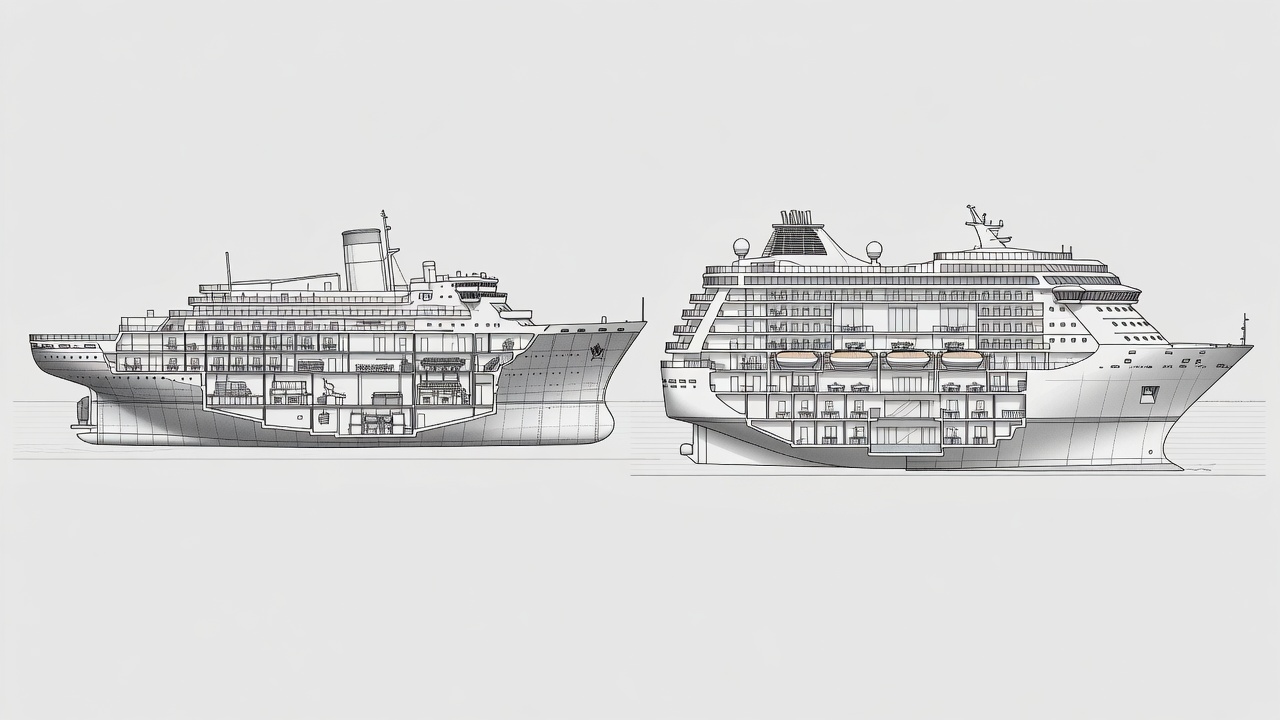
To the untrained eye, any large passenger vessel might be referred to as a "cruise ship." However, within maritime architecture and engineering, there is a strict and fundamental distinction between an ocean liner and a cruise ship. This guide explores the architectural blueprints, structural philosophies, and intended purposes that separate these two distinct classes of vessels.
Purpose and Routing
The primary difference lies in their purpose. An ocean liner is designed for "line voyages"—transporting passengers from point A to point B across an ocean, typically on a strict schedule, regardless of weather conditions. Historically, the most famous of these routes was the transatlantic crossing between Europe and North America.
A cruise ship, conversely, is designed for leisure. The voyage itself, rather than the destination, is the product. Cruise ships generally operate in warmer, calmer waters (such as the Caribbean or the Mediterranean) and often return to the same port they departed from. If a cruise ship encounters severe weather, the captain will usually alter the itinerary to find calmer seas, whereas an ocean liner must power through to maintain its schedule.
Hull Design and Steel Thickness
Because ocean liners must maintain speed through punishing winter storms in the North Atlantic, their structural integrity is paramount. Ocean liners feature significantly thicker steel plating on their hulls compared to cruise ships. For example, the RMS Queen Mary 2 (currently the only dedicated ocean liner in active service) features steel plating in its hull that is much thicker than that found on standard cruise ships.
Furthermore, the shape of the hull differs dramatically. An ocean liner possesses a deep V-shaped bow designed to slice through massive waves, whereas a cruise ship typically has a wider, boxier, U-shaped hull that maximizes interior volume and provides a flat, stable platform in calm coastal waters.
Draft and Superstructure
The "draft" of a ship is the vertical distance between the waterline and the bottom of the hull. Ocean liners have a much deeper draft to lower their center of gravity, increasing stability in rough open-ocean swells. Cruise ships have relatively shallow drafts. This allows them to enter a wider variety of shallow tourist ports, but it makes them more susceptible to rolling in high seas.
The superstructure (the parts of the ship above the hull) also varies. Cruise ships build upwards and outwards, often creating a top-heavy profile laden with balconies and open deck spaces. Ocean liners have a more enclosed, tiered superstructure designed to deflect wind and rogue waves. Lifeboats on an ocean liner are positioned much higher above the waterline to protect them from North Atlantic swells, whereas cruise ships often place them lower down for easier deployment.
Speed and Propulsion
To cross oceans efficiently and adhere to tight schedules, liners must be fast. The SS United States famously crossed the Atlantic at an average speed of 34.5 knots. The RMS Queen Mary 2 can achieve speeds of 30 knots. To achieve this, liners require massively powerful engines and a long, slender waterline.
Modern cruise ships, by contrast, rarely need to travel faster than 20 to 22 knots. Their itineraries are planned around leisurely overnight transits between nearby islands or coastal cities. Their propulsion systems are optimized for fuel efficiency and maneuverability—often utilizing azimuthing podded drives—rather than outright speed.
Summary Comparison
| Feature | Ocean Liner | Cruise Ship |
|---|---|---|
| Primary Purpose | Transport across oceans on schedule | Leisure cruising in calm waters |
| Hull Shape | Deep V-shape, long and slender | Wide U-shape, boxy |
| Steel Plating | Thick, reinforced for heavy seas | Standard marine thickness |
| Draft | Deep (often 10m+) | Shallow (usually 7-8m) |
| Speed | High (25-30+ knots) | Moderate (18-22 knots) |
Understanding these differences highlights why the RMS Queen Mary 2 remains a unique entity in today's maritime landscape, operating differently from the vast fleets of resort-style ships that dominate the contemporary vacation market.